blog

Shooting high key

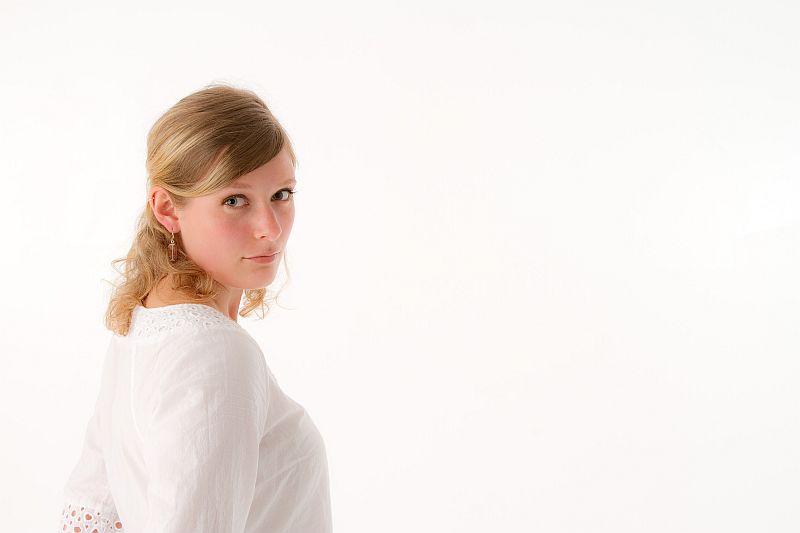
At the end of May I had the privilege of digitally photographing Heidi Wall, a young, virtuoso pianist who recently completed her degree in Music Performance at Wilfrid Laurier University. Heidi was interested in a high-key look with a solid white background, so for that we rented studio space in Stratford from Lori-Ann Franklin at Laf’s Photography. Kevin Garrett was my “assistant” – I use “assistant” in quotation marks since it became abundantly clear during the shoot who was the “teacher” and who was the “student”. The first issue in setting up the high-key shots was the relative power of the strobes to light the background, versus the power of the strobe filtered by the enormous octogonal softbox in the LAF studio. Ordinarily, when I use a white muslin as a backdrop I light it two stops higher than the light for the subject, to ensure that the background is white and that the creases in the backdrop do not show in the image – much harder to eliminate when using film than with digital. At the LAF studio, however,
Read More »

Acropolis

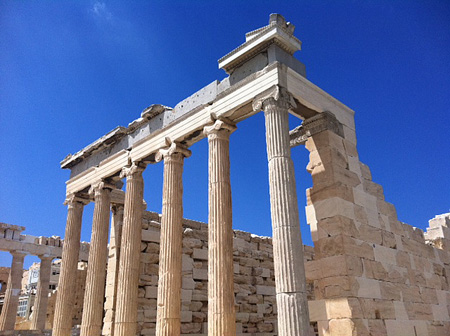
This morning I toured the Acropolis and the Acropolis Museum in Athens. For my trip I had planned to shoot 35mm Ilford FP4+ and Kodak Tri-X, and so had taken along my Canon Elan 7 with my Canon 24-105L IS zoom, with my old Canon Rebel and a Canon 50mm for backup. However, the website for the Acropolis Museum wasn’t enthusiastic about bringing camera bags to the museum – the Museum does not permit photographs whatsoever – so I left the gear at my hotel and went to the Acropolis with (merely) an iPhone. When that’s all you have, you make do – after all, if someone like David du Chemin can make worthwhile images with an iPhone, who am I to complain? I was pleased with the results – this image of the Erechtheion temple ruin at the Acropolis is my favourite – and I was helped greatly by the iPhone’s nearly infinite depth-of-field. If I have time while I’m here, I’ll go back to the Acropolis (and ignore the Museum) and try to do it justice in black-and-white.

Read More »

Bruce Barnbaum – The Art of Photography

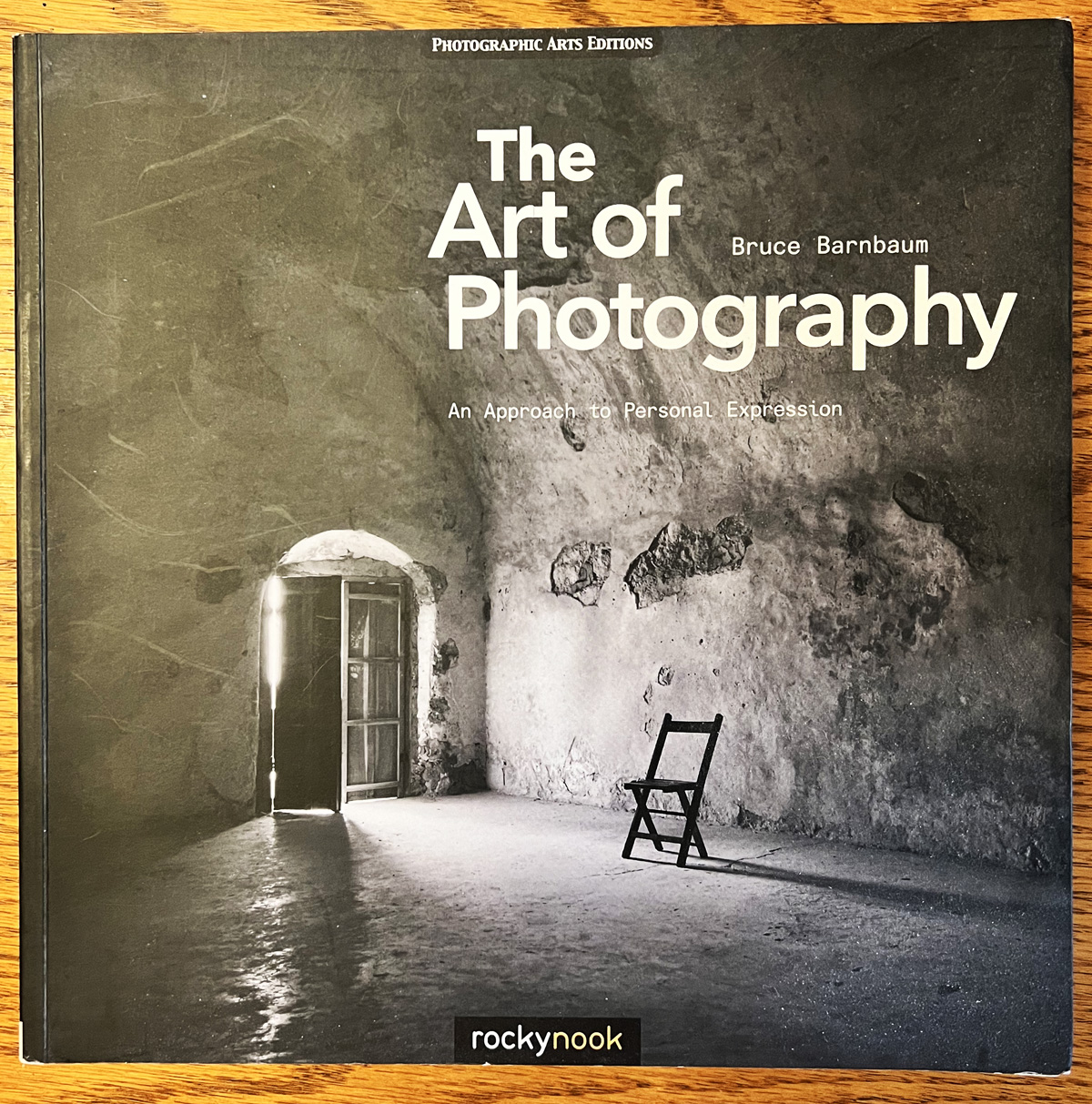
On a recommendation from Jim Blomfield I recently purchased a copy of Bruce Barnbaum‘s book, The Art of Photography, first published in 2010 and now – already – in its fourth printing. Jim was right; this is a great book, certainly ranking in the top five in my library. I purchased the book mostly because I have been a fan of Barnbaum’s black-and-white images for several years, and I wanted the book as a resource for helping me produce the finest gelatin silver black-and-white prints I possibly can. That detail – on characteristic curves, dodging and burning, paper flashing, etc. – is in the later chapters and provides some superb background for image-taking and darkroom technique, to complement my other excellent volumes on darkroom technique by Ansel Adams, John P. Schaefer, Henry Horenstein, and others. But what makes Barnbaum’s latest work important for every photographer, colour or black-and-white, film or digital, are the introductory chapters on composition, light, simplicity vs. complexity, line and form. These chapters make excellent reading, and provide the most lucid description I have yet read on

Read More »

Joy

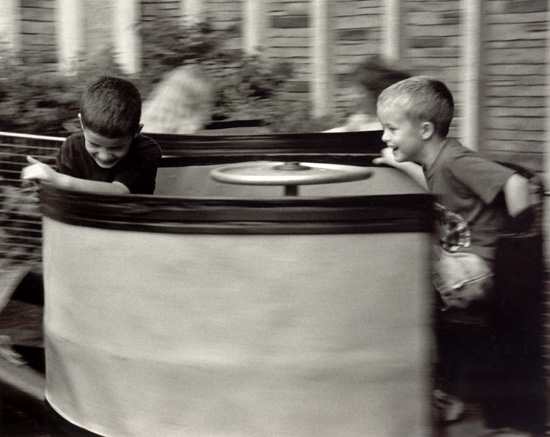
Canon Elan 7 with Sigma 24-70mm, with yellow #8 filter, using Kodak TMY 400 film developed with Ilford 2000. Exposure unknown. Printed on Ilford FB Warmtone glossy developed with Ilford Multigrade developer. Toned with Kodak Selenium toner 1:9 for 3 minutes. Famous French photographer Robert Doisneau, whose 2011 wall calendar graces my office, is often quoted as saying “If I knew how to make a perfect photograph, I’d do it every time”. I have certainly taken my share of poorly-constructed, ill-composed, out-of-focus photographs. During the 2004 Waterloo Busker Carnival I shot an entire 36-exposure roll of the boys, then aged six, on the children’s “tilt-a-whirl” ride, where each car rotates around three different axes – hence every shot was panned. The boys had a riot. The photograph is clearly unsharp, but I don’t care. It captures that moment for me.

Read More »

Notre Dame – Paris

This past September I attended a Dagstuhl workshop on Robust Query Processing, and chose to fly in and out of Paris rather than Frankfurt. On the weekends bookending the workshop I stayed at the Select Hotel in St. Germain, across the street from the famous Sorbonne. Luckily, the University was open to the public that weekend for tours and photographs, and I certainly took my share while I was there. For the trip I took my Manfrotto tripod, my favourite Mamiya C330S with 55mm, 105mm, 135mm, and 180mm lenses and forty assorted rolls of 120 film, largely Ilford FP4+ and Delta 400, with some Kodak Tri-X 400 thrown in. Being in St. Germain, it was an easy walk to Cite and Notre Dame Cathedral. I made several trips to Notre Dame over the two weekends, morning, afternoon, and evening, trying to capture better views of the cathedral’s architecture than I was able to in the summer of 2008. We’ll see what the prints bring, but here are the contact sheets of two rolls of Ilford FP4+.

Read More »

More Sybase marketing portraits

This past Monday I shot some additional portraits at the office. This time I utilized four different backgrounds: the glass-block wall and the black marble tile on the main floor, along with plain black and plain white backdrops. Each brought their own challenges in terms of lighting, and that’s what I’ll concentrate on here, featuring Barb who is a Partner Channels Manager for Sybase. It became clear early on that Barb’s photogenic side was her left. I first tried a lighting setup with the main light, a Novatron 500 monolight with large Photoflex softbox, positioned to the right of the camera, powered to f/8.5. I positioned a fill light, another Novatron 500 mono light with a medium-sized softbox, directly behind and above the camera at f/5.6.5. Finally, I positioned a small slave flash on a stand above and behind the subject to act as a hair light. While I liked the effect – I have used similar setups previously in the same location – as a second attempt I moved the main light to the left of the camera (the

Read More »
Scroll to Top