blog

Film or digital? And does it matter?

As I’ve been ill since the beginning of June, I’ve been unable to shoot and unable to print in the darkroom. So I spent my spare time re-reading some of my very favorite references on photography: Issue 83 of Lenswork magazine (July-August 2009), a tribute to photographer Bill Jay; On Being a Photographer by Bill Jay and David Hurn; Single Exposures – Random Observations on Photography, Art, and Creativity by Brooks Jensen; Within the Frame by David duChemin; and VisionMongers – Making a Life and a Living in Photography, also by David duChemin. I also went through some older issues of Lenswork magazine and re-read an editorial by Brooks Jensen from Issue 85 (Nov-Dec 2009) entitled “A Case of Mistaken Identity”. In this editorial, Brooks Jensen makes a point about one’s identity as an artist being defined by certain influences, some of which are internal and some are external. The case in point concerns the tiresome film vs. digital debate: Those of us who, like myself, defined ourselves with a certain style of photography using a prescribed kind of equipment

Read More »

The Schweigen Trio

Last Saturday I spent a very enjoyable afternoon photographing three talented (and charming) music students at Wilfrid Laurier University. They were Heidi Wall, Jeremy Bauman, and Miriam Stewart-Kroeker, who together call themselves the Schweigen Trio: All three of them exhibit a wealth of expression in their playing, and it was truly fascinating watching them play. Miriam, playing the cello, was perhaps the easiest to photograph since the size of the cello lends itself to a more varied range of movements, hand positions, and expressions. Camera: Canon 7D Lens: Sigma Ex 24-70mm @56mm Exposure: 1/160 sec at f/5.6 Flash: multiple Novatron 500 Camera: Canon 7D Lens: Sigma Ex 24-70mm @48mm Exposure: 1/160 sec at f/5.6 Flash: multiple Novatron 500

Read More »

Portraits with the Canon 7D

It’s been a busy week this past seven days: a shoot of a mortgage broker on Tuesday night; photographing the Schweigen Trio of Wilfrid Laurier University musicians on Saturday; and then shooting a subset of the sales and marketing teams at Sybase iAnywhere this past Monday. Here’s an example of the portraits from the shoot at iAnywhere, one I was particularly pleased with. The glass blocks at the entrance to the firm’s cafeteria formed an interesting background, with the glass exhibiting an olive-green hue from ambient light in the late afternoon. In this photograph of David from Sybase Product Marketing, I ended up using a single large softbox on my Novatron 500 mono lights, with David turning away from the light so that much of his camera side was in shadow. I thought this was easily the best image of the day: Camera: Canon 7D Lens: Sigma Ex 24-70mm @53mm Exposure: 1/160 sec at f/8 Flash: single Novatron 500 The Canon 7D performed flawlessly. The digital images are extremely sharp even when taken with the “medium” RAW format size. A

Read More »

Moving to split grade printing

On the way home from our most recent trip to Burlington for a Burlington Photo Art Group meeting, my friend Jim Blomfield convinced me to try split grade printing (see also this tutorial) rather than using the mixed-filter settings on my Devere 504 enlarger. The Devere supports filter grades from 0 to 4 (not 5) in 1/2 grade increments. Jim suggested that with split-grade printing I’d get better results since the light colour that is exposing the paper matches exactly the emulsions within it: magenta and yellow. So, on this latest batch of prints I’ve made of Saskatchewan I followed Jim’s instructions, and I’m pretty pleased with the results. Here is my favorite of those that I’ve printed thus far: Camera: Toyo 45CF field camera Film: Ilford FP4+ developed in Kodak D-76 Lens: Fujinon 135SW with red filter Exposure: unknown Print: Ilford Multigrade FB Warmtone Glossy developed in Ilford Multigrade developer This ranch house ruin is located in the West block of Grasslands National Park, south of Val Marie, Saskatchewan. I made this image while on a Wild Prairie workshop

Read More »

Qu’Appelle River, Round Lake

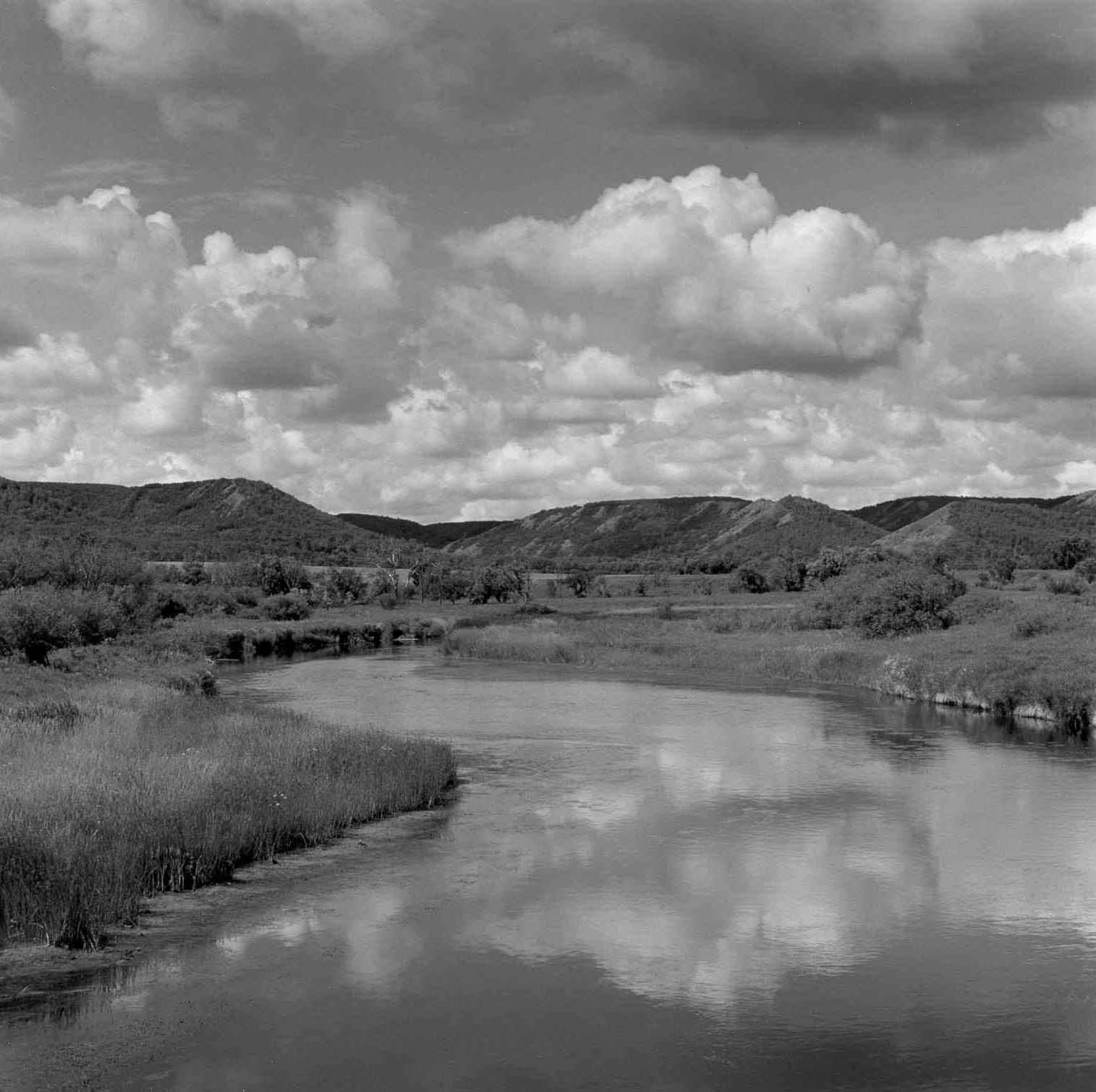
Over the last two months I’ve spent my darkroom time developing film taken during the summer – 15 rolls of 120 and nearly four boxes of 4×5 film taken in and around Grasslands National Park on James R. Page’s Wild Prairie workshop. This week I started making work prints of some of these images on Ilford RC paper; here is one example. This photograph is of the Qu’Appelle River, looking west (upstream) as it flows from Round Lake in southeastern Saskatchewan. It was taken from the old, abandoned Highway 9 bridge over the river that was built in the 1930’s. I had scouted out this viewpoint previously but the lighting wasn’t what I wanted until the morning that we left for Winnipeg – so I stopped the van on the shoulder, walked through the ditch to the old highway, and shot 2 rolls of Tri-X with my Mamiya C330S. This image is printed on Ilford RC Warmtone Pearl, developed in Ilford Warmtone developer. I like the slightly creamier whites with the RC Warmtone paper; I will likely use Warmtone FB

Read More »

Fun and games with colour calibration

Increasingly I find myself shooting more digital images, mostly because of web publishing – though there are a few occasions, certainly, where shooting digital makes a lot more sense. One example is my son’s hockey games. Arena lighting – at least those where my son’s team plays – is too dim for a decent (1/300) shutter speed with a fast (f2.8) lens, even at ISO 800. With film, the shots are so grainy that it’s hardly worthwhile. My new Canon 7D, however, with its highly improved noise reduction, means that I can get excellent images at ISO 1600. However, with digital comes the need for calibration to ensure that the colours in the image are as true as possible. Images that I’ve produced over the last few weeks I’ve post-processed on my DELL E6400 laptop. While the images looked fine on my laptop monitor, I thought they looked a little warm on another machine, but I had no way to determine which was correct until yesterday, as I didn’t have a calibration device. So this week I picked up a

Read More »
Scroll to Top