blog

Ansel Adams exhibition at McMichael Gallery

The McMichael Gallery in Kleinberg, ON, just north of Toronto, home of the McMichael Canadian Art Collection, is offering an exhibition of photographs by legendary photographer Ansel Adams and acclaimed Canadian photographer Edward Burtynsky from June 29 to September 29, 2013. In a career that spanned more than five decades Ansel Adams became one of America’s most beloved landscape photographers and one of its more respected environmentalists. There are few artists whose name and works represent the extraordinary level of popular recognition and artistic achievement as that of Ansel Adams. Writers, critics and fellow artists have presented many reasons for Adams’ popularity. Among them is his deeply held conviction that place matters and that the world around us is a marvel to behold and to respect and honor. There is a poignant and romantic feel to his photographs, as well as a celebration of the beauty of nature. The 47 photographs by Ansel Adams that will be on exhibit include Monolith – The Face of Half Dome; Aspens, Northern New Mexico; and Frozen Lake and Cliffs, and other famous photographs.
Read More »

Always remembered

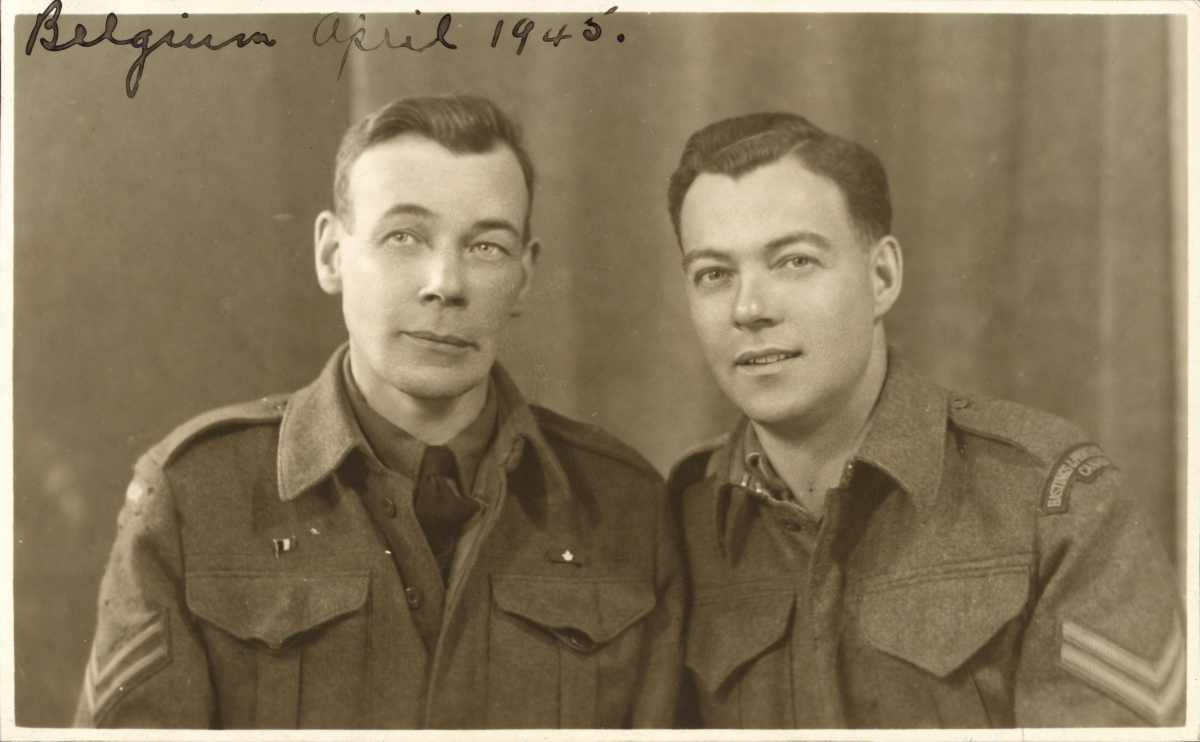
  This is one of my favourite photographs of my Dad (right), shown here posing with his older brother Les (left) in April 1945. My Dad was away on a short leave from his unit, the Hastings and Prince Edward Regiment, who at that time were in eastern Holland near Apeldoorn. My Dad had not seen Les since they enlisted together in 1942; my Dad had served in Italy with the First Canadian Infantry Division until their recent transfer to the Low Countries, while my Uncle Les was a quartermaster with the Third Canadian Infantry Division. Somehow my father had learned of my Uncle’s location in Bruges, Belgium, and my Dad took a short leave to see him that sunny April, whereupon they immediately found a portrait photographer to take their photograph in a studio somewhere in Bruges. As far as I am aware this is the only surviving print of that reunion. One reason that I enjoy this photograph is the contrast between my Dad’s uniform – with shirt unbuttoned and no badges or pins, showing the informality of

Read More »

Commonwealth War Cemetery, Yokohama

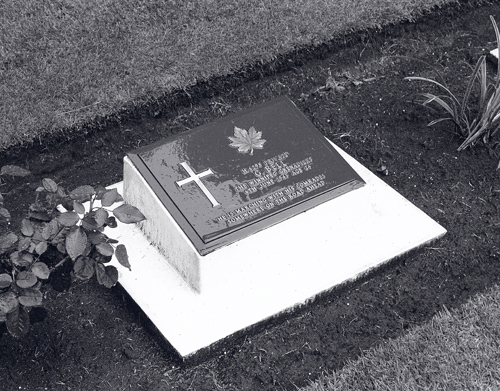
Few Canadians realize that Canada played a role, albeit a small one, in the Pacific theatre during the Second World War. In the summer of 1941, Britain asked Canada to provide reinforcements for the garrison at Hong Kong (until 1997 a British colony) and, in addition to a small complement of service troops, Ottawa sent two infantry battalions: the Royal Rifles of Canada, whose men came largely from the Eastern Townships, Quebec City, Gaspe and Northern New Brunswick, and the Winnipeg Grenadiers from Winnipeg. All together, approximately 2000 Canadian soldiers were sent to Hong Kong. The colony of Hong Kong fell under Japanese attack on 8 December 1941, the day after Pearl Harbor. With a pitifully small air force, no heavy weapons, and a nearly non-existent navy, the British garrison could only hold out for so long. They surrendered to the Imperial Japanese army on Christmas Day, 1941. Those who survived the Battle of Hong Kong were now prisoners of war. In captivity, the Canadians, along with units from Britain, New Zealand, Australia, India and Pakistan faced appalling conditions with

Read More »

Finally, a black-and-white digital camera

Yesterday the British Journal of Photography reported that Leica has announced a new rangefinder camera, the Leica “M” Monochrom, that includes an 18 MP, full-frame CCD sensor stripped of its conventional Bayer Pattern filter. As the camera does not “see” colours, says Leica, “every pixel records true luminance values to deliver ‘true’ black-and-white images that are significantly sharper than comparable exposures from a camera with a colour-sensitive sensor. On their website, Leica imaging writes on the Leica “M” Monochrom: The Leica M Monochrom more than satisfies the expectations of discerning users with a raw data histogram for the precise control of tonal values. The difference from conventional histograms is that it displays unprocessed and unmodified raw data. The combination of this with a configurable clipping display allows precise correction or optimisation of exposures. At the touch of a button, images captured by the M Monochrom can be converted with characteristic toning effects from black-and-white film photography (sepia, cold or selenium toning). All users need to do is save the image in JPEG format and select the desired toning effect –

Read More »

Autofocus and the Canon 7D

Much of my photographic efforts over the past six months have been devoted to curling, particularly since I became involved with the Laurier Golden Hawks High Performance Centre in November. Since then I’ve photographed a number of teams and clinics in a variety of different curling clubs. When setting up the High Performance Centre website, I consciously chose a grayscale theme because my intent was to convert all the curling photographs to black and white. My reasoning, which I think was sound, is that black-and-white photographs would unify the various images taken at different curling clubs, and also mitigate the issues with dim, fluorescent lighting used at many of them. The fluorescent lights at the Elmira and District Curling Club give a quite noticeable colour cast that is difficult to entirely eliminate, especially if flash is used as well. The more significant issue is the lack of light – at the K-W Granite Club in Waterloo, to shoot at ISO 800 I am forced to use f/4.0 (wide-open) at 1/60 sec with my Canon 17-40L. With the dim light, I’ve

Read More »

Lake Huron

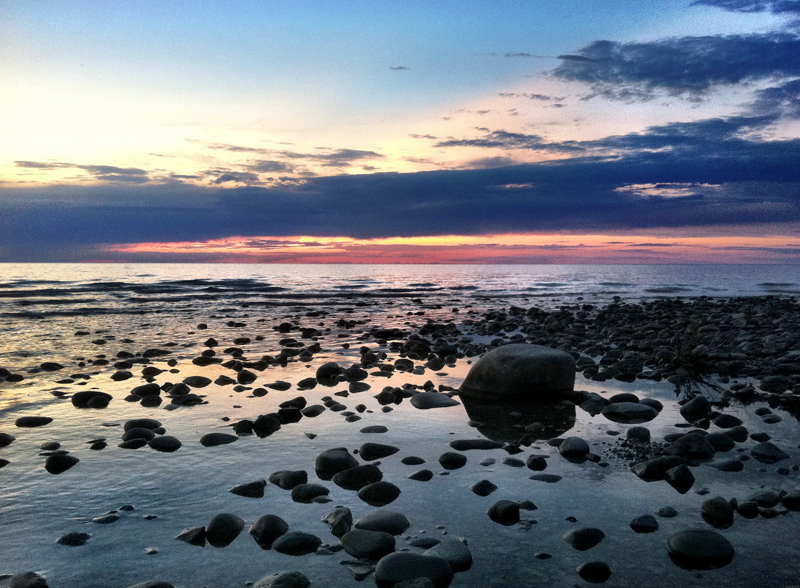
This past week my family holidayed on the shores of Lake Huron, near Kincardine, Ontario. For a lad from the Prairies, the Great Lakes are incredibly imposing, with an astounding breadth of water and a skyscape that has the potential to change every few minutes. On August 22, an F3 tornado hit Goderich, Ontario, about 54km south of Kincardine. While we witnessed much of the storm system as it crossed Lake Huron from the state of Michigan, Kincardine and beaches surrounding it received only a little rain. But the sky held drama, indeed, as I hope some of these photographs show. Over the week, I had intended to photograph the Lake Huron shoreline in black-and-white with my Mamiya C330S; but the drama of the skies in the low light, along with the blowing wind (and sand) on the beach, quickly changed my mind – and so instead I used the other camera at my disposal, which is on my iPhone. I have been impressed with the Camera+ software on iOS and it didn’t disappoint me here. The images aren’t suitable

Read More »
Scroll to Top